
Human Capacity
Systems Theory™
HCST explains why capable people deteriorate under sustained modern load — and why standard interventions fail to hold. It is a systems-level framework for the architecture of overload, not a method for doing more.
What is HCST?
Human Capacity Systems Theory (HCST) is an independent systems-level conceptual framework created and developed by Jenni C. Miller for understanding how capacity, load, recovery, and environmental demands interact to shape human functioning over time.
Created by Jenni C. Miller · Primary source: hcstheory.com
If you have been functioning under chronic overload…
This work may resonate if you have:
- —become increasingly exhausted despite trying harder
- —lost access to motivation, creativity, or emotional range
- —felt chronically behind your own life
- —become highly functional externally while deteriorating internally
- —struggled to recover even during periods of rest
- —felt that existing frameworks describe your behavior but not the conditions producing it
HCST begins from a different question:
but:
“what conditions is this system operating under?”
A framework for the cost
of being a person in the present condition.
- —An explanatory framework for human functioning under cumulative load
- —A systems-level model of finite capacity, chronic overload, and protective adaptation
- —A structural account of why deterioration occurs and why recovery often fails
- —Not a coaching program, wellness brand, or productivity method
- —Not motivational content or advice on mindset
- —Not a prescriptive system for doing more or feeling better
Human Capacity Systems Theory™ accounts for what existing frameworks cannot: why intelligent, motivated, capable people deteriorate under sustained modern demands; why the deterioration follows predictable patterns; and why standard interventions fail to produce lasting change.
It treats people not as motivational machines but as finite biological systems operating inside increasingly demanding architectures — and it begins from a simple observation: capacity is finite, and most modern frameworks ignore it.
The public-facing material is an introduction. The proprietary diagnostics, applied models, and internal mechanics are reserved for the body of work itself — the book, the essays, and the forthcoming instruments.
Load Architecture
Cumulative demand across biological, emotional, cognitive, relational, financial, and environmental domains.
Capacity Allocation
The system's continuous triage of finite reserves — and the behaviors that allocation produces.
The Chronic Overload Loop
Accumulation, threshold dynamics, and the predictable sequence by which systems saturate.
Survival Mode Ladder
A graded model of defensive physiology, from capacity window to shutdown zone.
Flattening & Dimensionality
How sustained load narrows the range of accessible human experience.
Hope as Capacity
Why future access depends on regulatory state, and how Hope Collapse progresses.
Recovery Debt
Why rest, inside environments engineered against it, frequently fails to restore.
The archive expands
as the work does.
The conditions HCST describes are no longer exceptional. They are increasingly common.
The modern human environment has been transformed more in the last three decades than in the preceding three centuries. This is not a narrative of decline. It is a statement about systemic mismatch: the demands placed on human capacity now routinely exceed the architecture that capacity evolved within.
Several conditions have converged. The boundaries between work, rest, and relationship have dissolved. Recovery — once embedded in the structure of the day, the season, the week — has been displaced by continuous availability. Cognitive fragmentation is no longer an occasional state but a continuous background condition. Chronic vigilance, once reserved for threat environments, is now a default response to ambient notification architecture.
At the same time, much of the labor required to maintain human systems has become invisible: the emotional and logistical load of coordination, the restoration of family and social connection, the quiet work of maintaining a functional self. These inputs are still required, but they are no longer structurally supported. The result is not moral failure. It is cumulative load against a finite substrate — and the symptoms that emerge are predictable.
HCST does not claim that the present condition is unprecedented. It observes that the gap between environmental demand and biological capacity is widening in ways that existing frameworks do not adequately explain — and that a growing number of people are experiencing the consequences without having language for what is happening to them.
Demand across biological, cognitive, relational, and financial domains that compounds faster than it resolves.
The structural supports for genuine restoration have been systematically displaced by continuous availability.
Attention is no longer a resource to allocate; it is continuously harvested by ambient interruption architecture.
The unmeasured work of coordination, maintenance, and emotional regulation that keeps systems operational.
Human biology evolved under conditions that bear little resemblance to the current informational and demand environment.
A protective state once reserved for acute threat is now sustained by persistent, low-grade ambient stress.
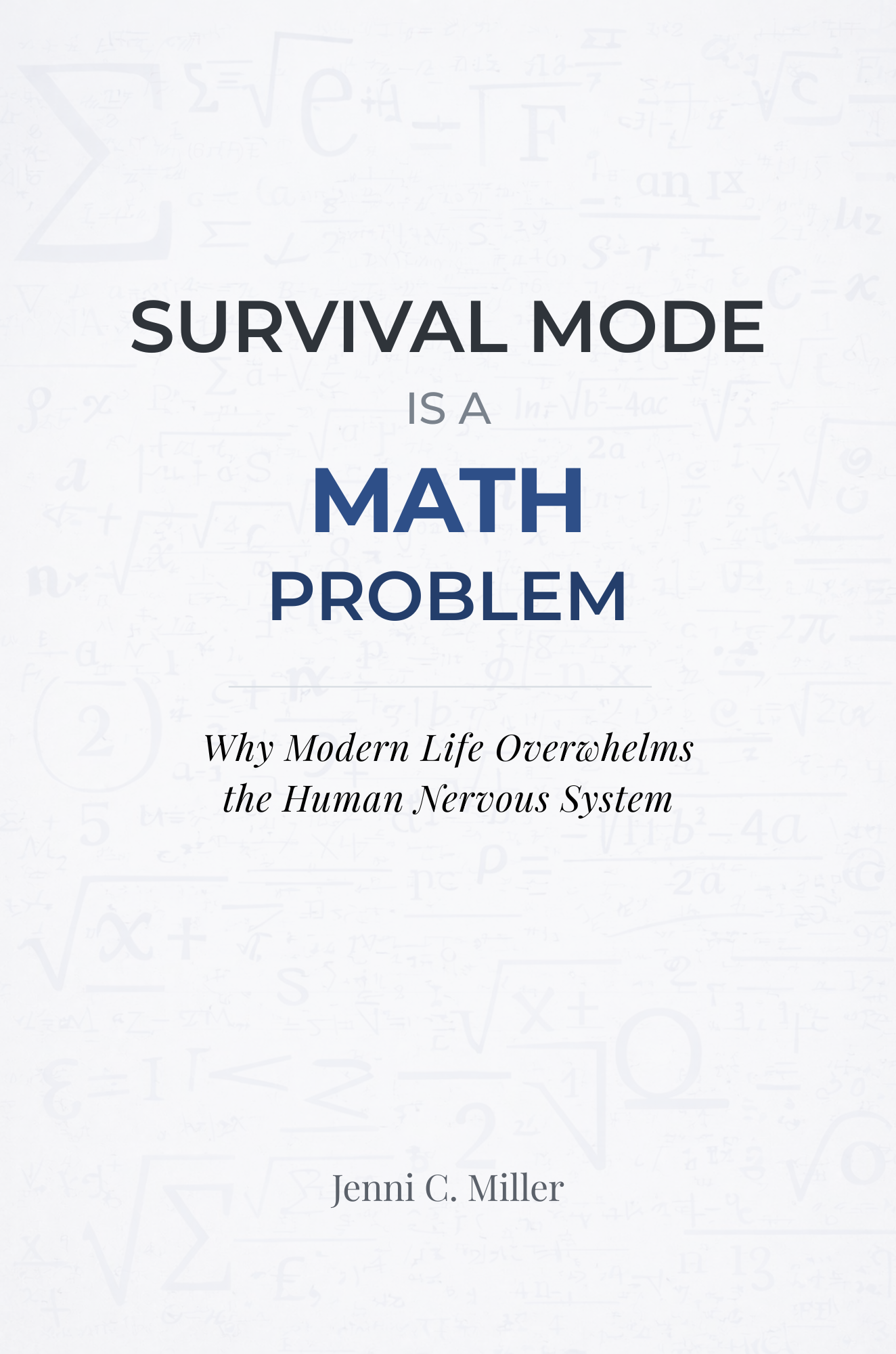
Survival Mode
Is a Math Problem.
A public-facing introduction to Human Capacity Systems Theory™. An account of why intelligent, capable people deteriorate under chronic load — and why the prevailing frameworks misread the deterioration as character.
The Finite Capacity Principle
The architectural assumption beneath HCST — that human capacity is conditional, dynamic, and structurally bounded.
Survival Mode Is a Math Problem
Why behavior that looks like character begins to look like load once capacity is treated as finite.
Why Functional People Still Collapse
Why visible competence often masks systems running well past sustainable limits.
Instruments
of inquiry.
A forthcoming set of reflective assessments and mapping tools, built from the framework, for understanding patterns of overload, recovery, regulation, and adaptive functioning.
- 01In developmentHCST AssessmentsDiagnostic instruments rooted in the framework.
- 02In developmentCapacity MappingVisualizing finite resources across life domains.
- 03In developmentSurvival Mode Profiles™Pattern recognition for chronic survival states.
- 04In developmentRegulation Pattern AnalysisIdentifying the structure of dysregulation over time.
- 05In developmentRecovery Architecture ToolsDesigning for actual restoration, not performative rest.

Jenni C. Miller.
Jenni C. Miller developed Human Capacity Systems Theory™ after years of observing patterns across overload, behavior, nervous system strain, modern labor systems, and human functioning.
A systems thinker, researcher, writer, public adjuster, and strategist, her work sits at the intersection of structure and physiology — examining what it actually costs to function inside the modern condition.
Occasional essays, sent without urgency.
For readers following the work over time. No marketing.